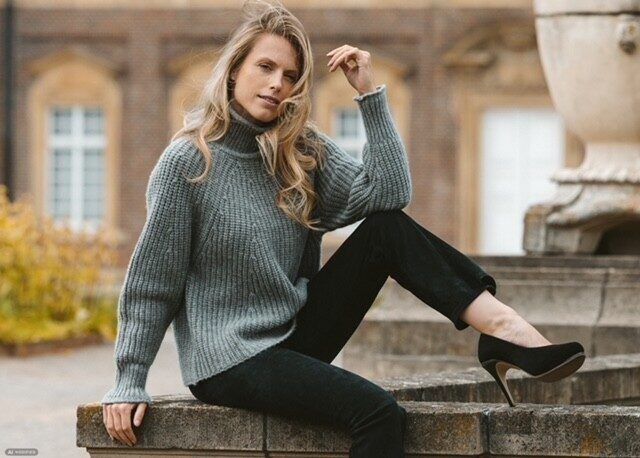
How small details make the difference
Linked seams, cuffs, handle and weight: six checks that let you judge the quality of a knitted piece yourself in two minutes.
Special

Often only millimetres separate a good garment from an exceptional one: in the seam, in the cuff, in the way the fabric falls. The good news is that those millimetres can be checked, without expertise and in two minutes. Here are the places we look at first ourselves.
The seam you are not meant to see
At the shoulder of a knitted piece two panels meet, and there are two ways to join them. The quick one is an overlocked seam: the edges are laid together, trimmed and wrapped. That takes seconds but adds bulk and stiffens the seam.
The demanding way is a linked seam. Stitch by stitch, each loop is picked up and joined, producing a flat, elastic connection. Run a finger along the inside of the shoulder seam: if you feel a ridge, it was overlocked. If the spot feels like the rest of the knit, it was linked.
The difference is not only about comfort. A linked seam stretches with the knit and therefore does not tear at the shoulder when you raise your arm. It is one of the reasons a piece still wears well after ten years.
Cuffs and edges
Cuffs are where a knitted piece ages first. The test takes three seconds: stretch the cuff firmly and let go. If it springs straight back into shape, the construction is sound. If it stays wide, it will do so permanently within a year.
Look as well at how the cuff is attached. In careful production it is knitted from the same yarn and joined seamlessly rather than sewn on as a separate band. On a piece such as the Albani Cashmere Jumper Sphinx you can see the rib structure run into the body without a break.
The handle reveals the fibre
Take the piece in your hand and squeeze it in your fist. Open your hand and watch what happens. Good cashmere recovers almost completely within a few seconds, because long fibre has high resilience. Lesser goods stay crumpled.
A second test: lay your palm flat on the knit and leave it there for a moment. Cashmere returns the warmth immediately without feeling damp. A blend with a high synthetic content stays cool at first and then turns clammy.
What you cannot check by touch is fibre length, and that is precisely what governs pilling. Only asking about the quality of the yarn helps there; how it all connects is covered in our piece on Italian knitwear craftsmanship.
Buttons, plackets and what hangs on them
On cardigans, the button band deserves a look. It should be backed with a tape, otherwise the knit pulls out of true under the weight of the buttons. On good goods the buttonholes are embroidered rather than punched, and the buttons themselves are sewn on with a shank so the band stays flat when fastened.
This sounds like small print, but it is the difference between a cardigan that still hangs straight after two years and one that ripples. On a piece with a full length band such as the Dolci Cashmere Cardigan Sphinx, these details carry the entire front silhouette.
Weight as an honest signal
Two jumpers in the same size can differ by thirty per cent in weight. The heavier one has more material in the surface, holds its shape longer and keeps you warmer. The lighter one feels more agreeable on the hanger and is, in case of doubt, simply knitted thinner.
That does not mean heavier is always better. For summer knitwear and for travelling, light is exactly right. It only means this: when two pieces look alike and cost the same, weight tells you which one has more material in it.
Six checks in two minutes
Feel the shoulder seam from the inside: flat or ridged?
Stretch the cuff and let go: does it spring back?
Squeeze the knit in your fist: does it recover?
Hold it up to the light: does the surface stay closed?
On cardigans, check the button band: backed, buttonholes embroidered?
Weigh it in your hand against a comparable piece.
Once you have practised these six points, you will recognise quality faster than through any label. And what passes these checks usually delivers what the price promises.
Frequently asked questions
What is a linked seam?
A join in which each stitch is picked up and connected individually. It stays flat and stretches with the knit, whereas an overlocked seam adds bulk and sits under tension at the shoulder.
How do I check the quality of a cuff?
Stretch it firmly and let go. If it springs straight back into shape, the construction is sound. If it stays wide, it will go slack permanently in everyday wear.
How do I spot cashmere with a high synthetic content?
Lay your palm flat on it. Pure cashmere returns warmth immediately and stays dry to the touch, while a high synthetic content feels cool at first and then turns clammy.
Is a heavier jumper always better?
No, but with two visually similar pieces the weight shows which one has more material in it. For summer knitwear and travel, a lighter knit is the better choice.
Why are embroidered buttonholes better than punched ones?
Because they bind the stitches instead of cutting through them. A punched hole frays over time, an embroidered one holds the edge and stops the band from tearing.
Do come to the showroom and run these checks on our pieces yourself. The full cashmere collection is available online as well.